Conflict and Community in Colonial New England: A Genealogist's Guide
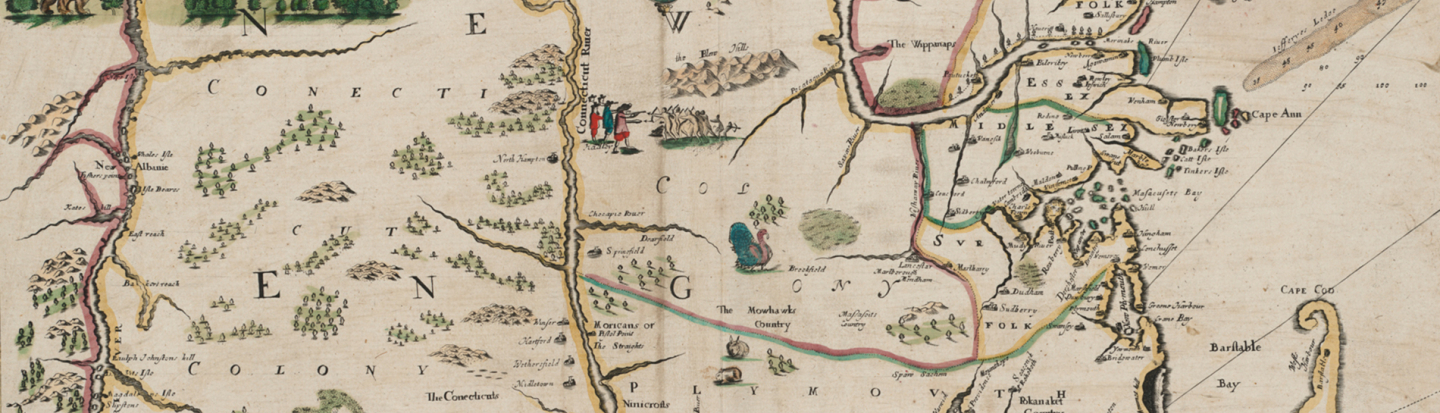
Conflict was woven into the history of colonial New England, shaping Indigenous nations and communities, European settlements, families, and individuals. For family historians, understanding these conflicts—and the people, communities, and political relationships involved—can provide essential context and reveal records that might otherwise be overlooked. This five-session online course explores the complex history of early New England, considering the varied experiences of the people caught up in changing alliances, competing claims, and military struggles. Along the way, participants will explore several types of primary and secondary sources that can help bring colonial ancestors into focus. From understanding the role of local militias and Indigenous diplomacy to navigating difficult research problems, the course offers clear paths to colonial-era research and understanding your ancestor’s role in early New England.
COURSE SCHEDULE
November 3 - Class 1: Colonial Communities at War: Towns, Militias, and Conflict
Presented by David Allen Lambert
Who were the key players and communities in this period? How did colonial communities organize for defense, and who was expected to serve? In this introductory session, Chief Genealogist David Allen Lambert will discuss the development of towns in New England and the prevalence and role of early militias. He will also provide a brief timeline of major conflicts in colonial New England.
November 10 - Class 2: Diplomacy, Alliance, and Conflict: Indigenous Nations and Colonial New England
Presented by Dr. Ian Saxine
From the 17th century into the early 18th century, relationships between Indigenous nations and European colonizers in New England were shaped by diplomacy, trade, cultural exchange, competing territorial claims, and warfare. These relationships were complex and continually evolving. This session explores the changing dynamics of these encounters and their lasting impact on communities and individuals.
November 17 - Class 3: Go-To Records: Finding Primary Sources and Manuscripts
Presented by David Allen Lambert
This session explores several primary sources and manuscript collections that can illuminate the lives of people affected by colonial conflict, including military, governmental, legal, land, town, church, and personal records. Participants will learn where to look, what these records can reveal, and how to use them to build a more complete picture of an ancestor and their community.
November 24 - Class 4: Beyond the Archives: Using Published Resources
Presented by Melanie McComb
Published histories, genealogies, local histories, military rolls, and other compiled resources can provide valuable clues for colonial research. This session introduces key types of published sources, how to evaluate them, and strategies for using them alongside original records to identify people, places, relationships, and events.
December 1 - Class 5: Breaking Through Colonial Brick Walls
Presented by David Allen Lambert
Colonial research presents its own special challenges: common names, missing maiden names, shifting boundaries, conflicting evidence, and unknown origins. The final session brings together the strategies covered throughout the course through case studies and problem-solving techniques. Participants will learn how to approach difficult research questions, follow unexpected leads, and use the historical context to break through colonial-era brick walls.
PRESENTERS
David Allen Lambert, Chief Genealogist has been on the staff of American Ancestors since 1993. David is an internationally recognized speaker on the topics of genealogy and history. Lambert has published many articles in the New England Historical and Genealogical Register, the New Hampshire Genealogical Record, Rhode Island Roots, Mayflower Descendant, and American Ancestors magazine. He has authored and or co-authored in the published genealogies presented to David McCullough, Ken Burns, Angela Lansbury, Michael and Kitty Dukakis, Nathaniel Philbrick, Doris Kearns Goodwin, and Boston Mayor Thomas Menino. He has also published eleven books including A Guide to Massachusetts Cemeteries (American Ancestors, 2018), and Vital Records of Stoughton, Massachusetts, to the end of the year 1850 (Massachusetts Society of Mayflower Descendants, 2008). David received his B.A. in History from Northeastern University. David is an elected Fellow of the Massachusetts Historical Society in Boston, Mass., and a life member of the New Hampshire Society of the Cincinnati and the General Society of the War of 1812. David also serves as the tribal genealogist for the Massachusett Tribe at Punkapoag in Massachusetts. His areas of expertise include New England and Atlantic Canadian records of the 17th through 21st century; American and international military records; DNA research; and Native American and African American genealogical research in New England.
Melanie McComb, Senior Genealogist, holds a Bachelor of Science degree from the State University of New York at Oswego. She is an international lecturer who teaches on various topics including colonial through twentieth-century American military research, genetic genealogy, Atlantic Canadian, African American, Jewish, and Irish genealogy. She is also an Honorary Fellow of the Massachusetts Historical Society. She has had articles published in American Ancestors magazine and Fifty Plus Advocate. She is a blogger, known as The Shamrock Genealogist.
Dr. Ian Saxine, Assistant Professor of History at Bridgewater State University, is a historian of early modern North America with a particular focus on Indigenous people and the Maritime Northeast. At Bridgewater State University, he teaches North American history up to the American Civil War era. His research focuses on colonial and Native American history, especially in New England. His first book, Properties of Empire: Indians, Colonists, and Land Speculators on the New England Frontier, was published NYU Press in 2019. Saxine was the Project Historian for the Eastham 400 program, reexamining the encounter between Wampanoag and Plymouth colonists on Cape Cod in 1620, and co-hosts the podcast Mainely History (with Tiffany Link, Maine Historical Society) featuring conversations about Maine and New England in the past, to better understand them in the present. He is co-editor (with Kristalyn Shefveland of University of Southern Indiana) of a new edited volume, The Great Upheaval: War, Migration, and Transformation in Early Modern America, 1675-1725 (University of Nebraska Press, 2026).